


The Politics of Police Reform: Society against the State in Post-Soviet Countries
When: April 20, 3.15-5.00 CET
Where: Sign up here for Zoom link
Dr. Erica Marat is an Associate Professor and Chair of the Regional and Analytical Studies Department at the College of International Security Affairs, National Defence University. She has previously directed Homeland Defense Fellowship Program at CISA.
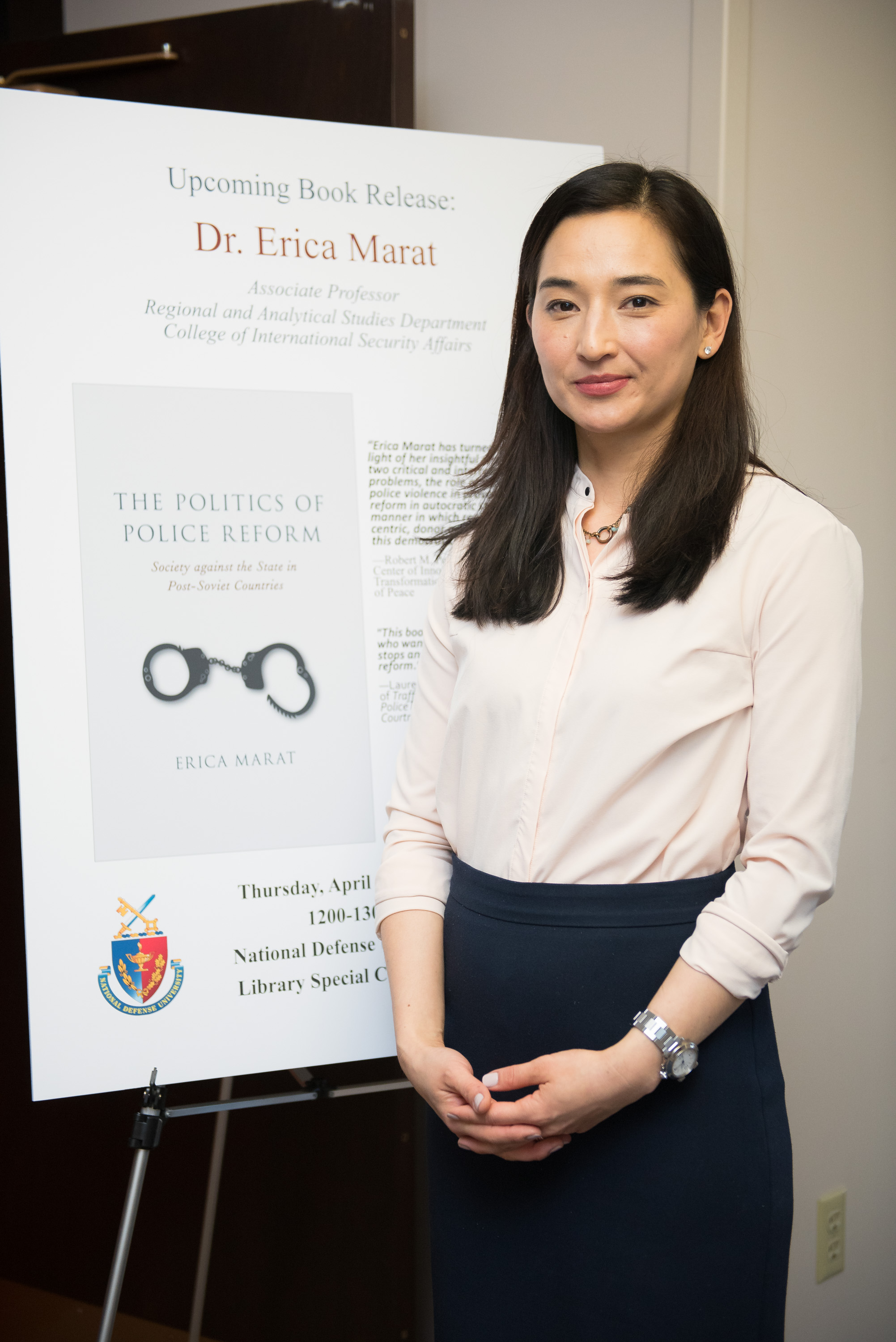 Dr. Marat’s research focuses on violence, mobilization and security institutions in Eurasia, India, and Mexico. During our seminar, she will present her book – The Politics of Police Reform: Society against the State in Post-Soviet Countries. What does it take to reform a post-Soviet police force? Across the region, the countries inherited remarkably similar police forces with identical structures, chains of command, and politicized relationships with the political elite. Centralized in control but decentralized in their reach, the police remain one of the least reformed post-communist institutions. As a powerful state organ, the Soviet-style militarized police have resisted change despite democratic transformations in the overall political context, including rounds of competitive elections and growing civil society. This book explores the conditions in which a meaningful transformation of the police is likely to succeed and when it will fail. Based on the analysis of five post-Soviet countries (Ukraine, Georgia, Kyrgyzstan, Kazakhstan, and Tajikistan) that have officially embarked on police reform efforts, the book examines various pathways to transforming how the state relates to society through policing. It develops a new understanding of both police and police reform. Departing from the conventional interpretation of the police as merely an institution of coercion, this study defines it as a medium for state-society consensus on the limits of the state’s legitimate use of violence. Police are, according to a common Russian saying, a “mirror of society”—serving as a counterweight to its complexity. Police reform, in turn, is a process of consensus-building on the rationale of the use of violence through discussions, debates, media, and advocacy.
 This panel was originally proposed to, and accepted by, the annual convention of the International Studies Association to be held in Las Vegas, April 6-9. As the convention for known reasons moved into a virtual mode, we decided to hold this panel outside of the formal ISA framework.
 Welcome to the RUCARR zoom seminar on February 9, 15.15.