


 You are invited to attend the RUCARR online seminar on October 6 The Caucasus in the Post-Covid Multi-Polar World with Dr. Lincoln Mitchell, affiliated to Arnold A. Saltzman Institute of War and Peace Studies, Columbia University (bio below).
When: October 6, 3.15-5.00 pm (Swedish time)
Where: Zoom platform
The seminar is open to staff and students as well as other interested. Welcome to sign-up at rucarr@mau.se.
Abstract
One of the results of the mishandling of the Covid-19 pandemic by the American government has been to accelerate the movement towards a truly multi-polar world. Instead of controlling the pandemic within its own borders and offering assistance to the rest of the world, the US suffered more loss of life and greater damage to its economy that most countries. One of the effects of this has been to damage not just America’s standing in the world, but also limit its ability to impact political events in the rest of the world. This development will be felt acutely in the Caucasus.
The three South Caucasus countries as well as the Russian regions in the North Caucasus have long had to navigate a path between major political powers, but the nature of that challenge began to change in 2017, when Donald Trump became President of the US, and has accelerated in recent months. These polities now find themselves in a very different world, one where the American footprint will be lighter and China’s almost certainly heavier. Additionally, the possibility of the world becoming less globally integrated will have major impact on a region that has long been a crossroads between different regions. These developments will have an impact on the domestic politics of the countries in the region on issues ranging from democracy and human rights to domestic stability as well as their relations with each other and the rest of the world including with regards to questions of trade, fighting terrorism and national security.
This seminar will explore these questions and probe how the Caucasus will be changed by the Covid-19 pandemic.
Bio
Lincoln Mitchell is a political analyst, pundit and writer based in New York City and San Francisco. Lincoln works on democracy and governance related issues in the former Soviet Union, Eastern Europe, the Caribbean, the Middle East, Africa and Asia. He also works with businesses and NGOs globally, particularly in the former Soviet Union. Lincoln was on the faculty of Columbia University’s School of International Affairs from 2006-2013. He retains an affiliation with Columbia’s Arnold A. Saltzman Institute of War and Peace Studies and teaches in the political science department as well. In addition, he worked for years as a political consultant advising and managing domestic political campaigns. […] Continue reading: http://lincolnmitchell.com/about
 Drug discourses in Russia
 A book with the intriguing title
 Dr. Mikhail Suslov: Fantasy and Politics in Contemporary Russian Science Fiction

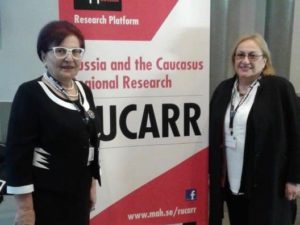
 RUCARR på Almedalsveckan – 6/7 2018 14:00 – 15:20
 I mars 2018 valdes Vladimir Putin till Rysslands president för fjärde gången. Landet har under hans snart tjugo år vid makten utvecklats i alltmera auktoritär riktning. Utåt har Ryssland allt oftare talat ett hårdhänt maktspråk såsom vid annekteringen av Krim samt krigen i Ukraina och Syrien. Landet gör nu tydligt anspråk på att utmana USA och spela en global roll. En förklaring till Putins starka stöd på hemmaplan är att han upplevs som garant för Rysslands starka ställning i världen och för intern stabilitet. Samtidigt är hans position i rysk politik så unik att frågor uppkommer om vad som kan hända när han lämnar presidentposten. Enligt konstitutionen måste så ske senast 2024, men presidentvalet visade att det knappast finns några trovärdiga utmanare idag. Inte heller har Putin pekat ut någon efterträdare. Vilket agerande kan förväntas av Ryssland under kommande år? Och hur påverkas Sverige och dess närområde av allt detta?